Visual Communication Solutions

(631) 477-0277
webpro1@optimum.net

Monday, October 18, 2010

Facebook advertising will perform in 2011

The UK’s online advertising spend increased 10% to nearly £2bn in the first half of 2010 according to the IAB. For the first time the survey estimated spend on social networks, at 3% of total online spend. 
Though that’s a rough-and-ready figure, it probably represents around £40-50m in the first 6 months of 2010. There’s no doubt in my mind that a lot of that social spend is going on Facebook and we’ll see that increase considerably through 2011.
The reason?  Facebook is building a powerful performance marketing channel that takes advantage of the enormous amount of user data they have.  Precisely targeted ads, priced by advertisers through an auction system can be shown to any of Facebook’s 500m active users. 
If that ad platform sounds familiar, don’t be surprised – a company called Google has being operating a similar system for the last few years and is doing pretty well from it.
Performance marketing, in its proper sense, is on the up. And it’s changed. Gone are the old ‘throw enough (cheap) mud’ techniques of the very first ad networks. In their place are online ad campaigns that cross the paid media platforms of search, display and social; proper customer attribution analysis, online and offline; measurement based on financial metrics not eyeballs; and predictive and analysis technologies that help marketers plan their budgets based on the best, or combination of the best, performance platforms.
Of course, this kind of marketing has been borne out of the technologies originally associated with search, and so search specialists are leading the way, integrating display and social advertising into their search campaigns. 
Automated bidding platforms, predictive modelling techniques and sophisticated analytics have all made it possible to understand the customer path across online platforms from first search to purchase and target based on specific customer data, rather than buying generic space on a single site.
For the right price, Facebook ads can offer great value at the moment. Of course, getting the targeting right, and bidding the right amount based on that targeting, is critical, as it is with search or other display ads. But the biggest change coming is in the way advertisers can work across these platforms.  It’s possible now to manage a display, Facebook and search campaign in one place, which means you can adjust the campaign, shift budget from one to the other, and improve performance across all three.
In the new world of performance marketing, the whole really is greater than the sum of its parts.

Friday, October 15, 2010

Make Your Facebook Content “Top News”

One of the main aims of companies using Facebook for business is generating awareness, as  pointed out in the Facebook Success Summit session on Tuesday afternoon. The top way to do this is to win the News Feed. It seems simple: If you get someone to “like” your company’s Facebook page, then they receive the content you send out, right?
Not exactly.
Your news feed is divided into two sections, “Top News” and “Most Recent News,” and people are automatically directed to their “Top News” feed when they log in. Facebook has even acknowledged that 95% of users only read their “Top News” version of the feed. Thus, to stay on your customer’s radar, your content must fall into the “Top News” category.
“Top News” is determined by the Edge Rank, an algorithm that reflects three components:
  • Affinity Score: The amount you have historically engaged with content by a person/page increases your affinity to the content creator.
  • Timing: The more recent the post, the higher it ranks.
  • Weight: As posts are commented on, liked and shared by other Facebook users and their networks, their overall weight increases.
So, what should you do to continue to appear in the “Top News” section of the News Feed?
  • Post content frequently. This increases your chances via the timing angle.
  • Consider your post timing. Only 35% of Facebook users log in during the workday, research shows. That means “off hours” might work best for posting your content.
  • Use calls to action in your posts. Encourage your fans to like, comment, or share your content to increase the weight.

Wednesday, October 13, 2010

YuMe Rolls Out "ACE for Advertisers" For Improved Video Ad Management

Video ad network YuMe is rolling out a new product this morning called "ACE for Advertisers" that is being positioned as an end-to-end buy side video ad management system. According to YuMe, ACE for Advertisers offers enhanced control of media planning and buying, ad trafficking and creative management, ad serving and optimization and post-campaign analytics. It can be used across online, mobile and IPTV.

ACE for Advertisers is further evidence of how the online video advertising industry is maturing, with new tools to help major brands and agencies operate at higher scale and move bigger budgets into the medium. For example, YuMe said that ACE for Advertisers allows users to buy directly from publishers by configuring their own private networks, and/or they can tap into YuMe's network of 600 publishers and/or they can use other ad networks or exchanges. In effect, if there's inventory out there to capture, YuMe wants brands and agencies to be able to reach and manage it through ACE. Targeting data from 3rd parties can also be incorporated across these networks.

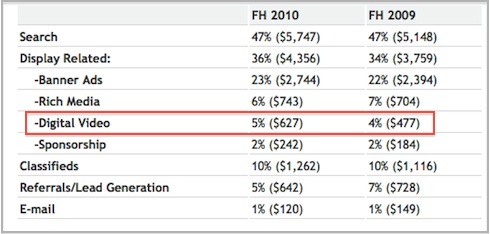
YuMe's announcement comes on the heels of new research from PwC and IAB yesterday that noted that video advertising was the best-performing category of Internet advertising in the first half of 2010, up 31% to $627 million. While impressive, it's still only 5% of the market, and a minuscule percentage relative to the $60 billion/year in TV advertising.
There is a massive amount of momentum behind online video advertising, and the key to realizing its potential is for brands and agencies to have the proper tools to efficiently plan, buy, manage and evaluate online video campaigns. All of the major online video ad companies recognize this, and as with ACE for Advertisers, they are moving rapidly to bring these new buy side products to market.

Online Video Advertising is Best Performer in FH '10, Up 31% to $627 Million


  Online video advertising is the fastest-growing ad category on the Internet, up 31% to $627 million in first half 2010 from $477 million in first half 2009 according to new research released by PwC US and the IAB.

However, video advertising still only amounts to 5% of total Internet ad spending, with search, at 47% (over $5.7 billion in FH '10) still dominating the landscape. However, video advertising is benefiting significant tailwind and is poised for lots of growth ahead. In its favor are shifting consumer behaviors toward online viewing, an exploding array of premium-quality/brand-friendly content, broad adoption of connected device which enable long-form online-delivered video viewing on TVs, and improved ad infrastructure (e.g. targeting, management, engagement, etc.).

When I talk to executives at video ad networks, brands, agencies and content providers they all confirm lots of activity in moving over TV and online budgets to video. I expect plenty more of this as online video viewership gains further momentum. The full ad spending breakdown for FH '10 is below.

Friday, October 8, 2010

10 Top Reasons To Put Video On Your Site

Ten Compelling Reasons Video Is So Important


We believe video makes a website more human, more accessible and more appealing. But then, as we make videos for a living, you'd probably expect us to say that. So we put together my top ten statistics from research findings, I think you’ll agree that the case for well crafted web video is overwhelming!
  1. "Brands using online video have seen lifts of 20% to 40% in terms of incremental buying, with conversions that are twice the rate of other media." (1)
  2. 21% of web video viewers make a purchase online. (1)
  3. 26% of  web video viewers visit a web store. (2)  
  4. 21% of web video viewers request more information. (1)
  5. Video landing pages generate four to seven times higher engagement and response rates than static image and text landing pages. (3) 
  6. Well optimised video is fifty-three times more likely than text to appear on the front page of Google. (4) 
  7. 68% of the top 50 Internet sites use web video. (5) 
  8. 71% of Internet users watch video. (1) 
  9. 65% of all videos are viewed between 9am and 5pm, Monday to Friday. (1) 
  10. 33% of middle managers view relative videos every day. (1) 

SOURCES:

(1) Chris Crafton, CMO, eCorpTV.com, reported by Target Marketing at a Philadelphia Direct Marketing Association networking and breakfast meeting.
(2) BIA/Kelsey User View study data, February 2010, reported by Turnhere.com.
(3) SearchEngineWatch, February 2010.
(4) Forrester Research, January 2010 .
(5 ) Internet Retailer, July 2010.

Tuesday, September 14, 2010

Live Streaming Video Jumps 600% in Past Year

Andres Palmiter/Comscore 

Nearly a decade before anyone had heard of YouTube, the first viral video spread among snickering teens and procrastinating college students. Discovered via direct download links and embedded QuickTime players, Trey Parker and Matt Stone’s “The Spirit of Christmas” not only launched what would soon become the popular animated series “South Park”, but also reinvigorated an entire cable network. What I remember most about “The Spirit of Christmas” was not the story (or the salty language), but the size and quality of the video. The file was huge! And it took close to a day to download! Even after the download bar clicked through to 100%, the video quality was still a fraction of what you’d experience on TV.
A lot has changed in last 10+ years. YouTube, once maligned for its streaming quality, can now pump out videos in 4K (for the uninitiated, that’s 4x the pixels of broadcast/cable HD), most online TV programming can be found in HD, and even the cheapest camcorders have the capability to upload a HD video. All those extra pixels require bandwidth and computing muscle; and fortunately, over the past two years publishers and portals have made the necessary technology investments to create a significantly better viewing experience. Live streaming video, however, with its own pernicious set of tech requirements, has lagged behind the larger Video-On-Demand portals and publishers in terms of consumer experience.
Now more than ever, live online video sites are willing to build out their technology infrastructure to provide a better user experience. For instance, Justin.tv recently announced mobile applications for Android and iOS, the former allowing users to live stream from their mobile device. The growth of broadband (both through regular and cellular networks) has made features unthinkable two years ago a reality today. What’s the payoff? Over the past year, the amount of time American audiences spent watching video for the major live video publishers (Justin.tv, USTREAM, Livestream, LiveVideo, and Stickam) has grown 648% to more than 1.4 billion minutes. By comparison, the amount of time American audiences spent watching YouTube and Hulu increased 68% and 75%, respectively, over the same time period. Though the amount of time spent watching live video is still only a small fraction of the total time spent watching online video, its sharp growth indicates viewers’ growing comfort with the content.
Live online video sites have not only been successful in building audience, but also in keeping that audience tuned-in. For instance, the average live streamed video view is 7% longer than the average online video view. If you narrow the audience to a specific demographic, though, live video really begins to prove its advertising value to media planners. Live video sites are 72% more likely to deliver the elusive demographic, males age 18-34, than the average online video site. In fact, males age 18-34 comprise almost 30% of the total live video viewing audience in our sample sites. Even without the same brand recognition as other portals and publishers, live video sites are able to retain viewers’ attention and deliver desirable audiences for advertisers.

In particular, Justin.tv, USTREAM, and Livestream have exhibited tremendous growth over the past year and are vying for supremacy as the leading live video publisher. In July, USTREAM reached more than 3.2 million unique viewers, with Justin.tv reaching 2.6 million and Livestream 2.4 million. Livestream, though, served more than 160 million videos, compared to roughly 130 million from Justin.tv and 20 million from USTREAM. Those 20 million videos on USTREAM, however, were viewed eight minutes longer on average than videos on Justin.tv and 17 minutes more than those on Livestream. In terms of total minutes, viewers logged nearly 900 million minutes watching Justin.tv in July, outpacing the other two sites.
Although live video sites may not have the cachet or visitor base of more established broadcast brands or larger video portals, they do provide a savvy planner with the tools to reach valuable targeted audiences. As live-streaming technology moves more mainstream content creators will increasingly realize the importance of mirroring their live TV strategy with live online video.

Wednesday, September 8, 2010

3 Studies Show Facebook’s Marketing Potential

Facebook is hot. There’s no question that Facbeook has a large audience. But what does this mean for marketers and business owners?

Here are three recent Facebook-related studies that answer these very questions by examining how much time Facebook users invest in the platform, if Facebook ads are effective and other Facebook trends among online merchants.
#1: One-Third of Online Time Spent on Facebook Among U.S. Users

According to recent findings by market researcher Morpace, U.S. Facebook users are on the site for 1 of every 3 minutes of time spent online. Users 18 to 34 years old spend the most time on the site per week (8.5 hours out of 22.4 spent online). Users 55 and older spend an average of 4.6 hours per week on Facebook.

The study also explored Facebook activity by ethnicity. According to the results, Asians were the heaviest users of Facebook. As a group, they devoted the most of their Internet time per week to Facebook (39.6%). African Americans were the second heaviest users at 35.1%. Hispanics spent the least amount of time on Facebook (31.7%).

One of the most interesting stats from this study showed that Facebook users making at least $100,000 annually spent the most time on Facebook and on the web as a whole. This is valuable information for companies selling products and services online.
#2: Facebook Ads Most Effective On User Profile Pages

Facebook users spend more time looking at ads on their own Facebook profiles than they do on news feed pages (their homepages), found a new report by Mulley Communications. Specifically, the study found that 71% of users looked at advertisements on their profile pages, while only 31% of users looked at advertisements on the news feed page.

In addition, 53% of users pay attention to page updates in their news feed wall, which may explain why they mostly ignore ads on their pages.

#3: Online Merchants Loving Facebook ‘Likes’

There’s been a lot of discussion about retailers extending the power of Facebook to their sites. Website conversion company SeeWhy found that 35% of ecommerce online marketers have implemented Facebook’s “Like” plugin, while 33% plan to do so in the near future.

The second most popular Facebook social plugin was the login application, as 18% reported they had implemented it and 15% said they plan to do so in the future. The login plugin allows consumers to skip the registration step and login directly from the merchant’s site. This allows conversion to be simple and quick, which is a huge advantage for the merchant.

Facebook social plugins have been getting a lot of attention from online merchants because they can drive traffic back to their own sites without having to build an entire ecommerce site into their Facebook page. Although 26% of respondents said they plan to build ecommerce applications on Facebook itself, 67% said they plan to use Facebook to actually drive traffic to their sites.

In addition, 44% said they plan to use Facebook applications in place of microsites for launches and specific promotions.